
Royal Buffet & Grill in Akron, Ohio, is a homegrown establishment that has become a staple for lovers of Chinese and Japanese cuisine. However, its journey has been marred by serious legal challenges that impacted the business and the community it serves. This article explores the dual aspects of Royal Buffet & Grill—its legal challenges, primarily stemming from immigration and tax-related issues, and its extensive culinary offerings, which continue to draw in patrons. By examining these facets, business owners can glean important lessons about compliance and the importance of quality service in ensuring long-term success.
Legacy Under Scrutiny: Immigration, Tax, and the Akron Chapter of Royal Buffet & Grill
The chapter of Royal Buffet & Grill in Akron is not just a tale of a local dining room. It is a study in how a long-running, family-involved enterprise can become a focal point for questions about labor, law, and community accountability. Located at 1930 Buchholzer Blvd, the restaurant has loomed large in local memory as a place where families gathered, friends met, and a broad audience accessed a shared cultural dining experience. Yet the record that shapes its public perception is colored by federal actions that exposed a complex web: workers who relied on the restaurant for income, owners who faced serious legal exposure, and a system of rules designed to ensure fair labor practices and proper taxation. Reading the Akron case requires stepping beyond the menu and into the structure of employment, verification, and reporting that underpins all modern small businesses. The narrative invites readers to weigh opportunity against obligation, and to consider how communities absorb and respond when trusted local establishments become sites of legal scrutiny. The Akron site, a real address in a bustling city, becomes a lens through which to examine broader questions about responsibility and resilience in immigrant entrepreneurship.
The heart of the legal challenges centers on immigration-related violations. In 2017, the owners, Zhou Qiang Zou and Xin Hsu, faced federal convictions for harboring and employing undocumented workers over more than a decade. Official records indicate that at least fourteen individuals were affected, with employment spanning from the early 2000s to the mid-2010s. The practices described include hiring workers who lacked authorization, compensating many at wages that did not fully reflect legal requirements, and relying on tips to bridge gaps in compensation. The operation reportedly extended beyond the restaurant floor, as some workers were housed in a nearby residence and transported daily by a van to the business. This picture of labor arrangements challenges the public to separate concerns about economic necessity from legal obligations, all while recognizing how immigrant workers can be drawn into informal networks that may blur the lines between accommodation and exploitation. The implications for labor standards are stark: employers carry a duty to verify work authorization and to compensate employees in a transparent, lawful manner. The DOJ, Homeland Security Investigations, and IRS Criminal Investigation all contributed to the investigation, underscoring how interlocking federal responsibilities govern employment, housing, and taxation in these situations. The case is thus not merely about penalties, but about the standards that sustain fair work across a diverse community of workers who often depend on such establishments for access to livelihoods and a sense of belonging in the city.
Beyond immigration, the case exposed substantial tax irregularities. Prosecutors revealed that approximately a million dollars in income had gone unreported over a ten-year period. The resulting tax loss was estimated at around one and a half million dollars to the federal government. This dimension of the case underscores a second core responsibility for business owners: accurate accounting and timely reporting. Tax compliance is not a private matter; it shapes public revenue, contributes to shared services, and sets expectations for how a business sponsors its employees and operations. When income remains off the books, the line between legitimate business risk and deliberate noncompliance becomes dangerously blurry. The legal process highlighted how deliberate underreporting — whether through concealment, misclassification, or other means — jeopardizes not only government funding but also the trust customers place in a local business. It is a reminder that the health of a community’s economy depends on transparent practices, from point-of-sale records to payroll and tax returns. The investigation united agencies in a common purpose: to enforce the laws that govern business finance as a public trust, and to delineate the penalties for those who evade them.
The consequences reflected a decisive, if sobering, judicial response. Zou received eighteen months in federal prison, followed by deportation to China, while Hsu drew a nine-month sentence plus an additional nine months of electronic monitoring at home. These outcomes illustrate the severity assigned to combined immigration and tax violations when they are tied to a business operation. The sentences also demonstrate the federal system’s insistence on accountability that extends beyond the courtroom’s walls, signaling to all employers that the costs of noncompliance extend into personal liberty and future residency status. In Akron and similar communities, such penalties reverberate through the fabric of local business networks. They spark conversations about compliance programs, employee verification protocols, and the kind of governance that can prevent similar missteps in the future. The agencies involved, including DOJ, HSI, and the IRS Criminal Investigation Division, point to a coordinated federal approach to corruption and labor abuses in small-business settings. This case sits at the intersection of labor rights and fiscal responsibility, two pillars that any thriving neighborhood economy must uphold.
The broader implications for the local ecosystem are nuanced. On one hand, the episode raises legitimate concerns about worker vulnerability and the potential for exploitation within immigrant labor networks connected to family-run businesses. On the other hand, it invites a careful consideration of how communities value ethical entrepreneurship and how they reconcile past misdeeds with the possibility of reform. The Akron restaurant world, like many similar city landscapes, lives in the tension between heritage and reform. A chain of questions follows: How does a long-standing neighborhood institution regain credibility after a public legal ordeal? What governance changes are required to align operations with federal requirements without erasing the human stories that once defined the business’s identity? In many cases, such questions lead to stronger compliance measures, clearer human resources practices, and renewed emphasis on transparency in financial reporting. They also motivate owners to seek guidance on lawful recruitment, employment verification, and wage practices that guard both the workers and the business’s future. The aim is not merely to appease regulators, but to build a resilient framework in which staff feel secure and customers can trust the enterprise to act with integrity.
Despite the gravity of the offenses, the Akron chapter emphasizes the complexity behind what outsiders might label something as straightforward as a local dining venue. Immigrant-owned businesses often operate at the margins of formal economic systems, balancing opportunities with risks. The legal record invites readers to imagine pathways for renewal: establishing formal training on legal hiring, adopting standardized payroll processes, and pursuing third-party audits to ensure ongoing compliance. It also invites the community to reflect on the role of such institutions as social hubs, not only as places to eat but as anchors for family livelihoods and cultural exchange. In this light, the restaurant’s story becomes less a footnote of crime and more a case study in transformative governance. The public conversation around the Akron site can evolve toward constructive action—fostering awareness, providing resources for compliance, and supporting legitimate avenues for immigrant workers to participate fully in the local economy. Integrating these lessons into the operational DNA of a long-standing local business can help preserve the community’s connective tissue without compromising regulatory obligations.
Within this context, consider the way readers encounter the Akron location when seeking information about the broader Royal Buffet & Grill network. For a sense of the brand’s local presence and offerings, one can explore the Akron profile through related pages that discuss nearby locations and services. This internal pathway, such as the page dedicated to Chinese Buffet Akron Ohio, provides continuity for readers tracing a coherent geographic story while keeping attention on the unique history of this particular Akron chapter. https://royalbuffet.shop/chinese-buffet-akron-ohio/ The aim is not to draw a straight line from past lapses to present choices, but to cultivate a narrative in which the community learns from history and refines its standards for fair labor, accurate reporting, and responsible stewardship. Readers are encouraged to view the broader franchise context with a critical yet constructive eye, recognizing that growth for any family-run enterprise hinges on principled compliance as much as on hospitality and menu breadth.
In closing, the Akron case remains a potent reminder of how legal frameworks shape the daily operations of local eateries and the lives of their workers. It challenges owners to implement robust compliance practices and calls communities to hold businesses to high standards of transparency. The outcome is not merely a matter of punishment or reputation; it is a catalyst for lasting change that can secure the future of immigrant-led ventures while protecting the integrity of the local economy. For those who follow the full record, the story underscores a principle that applies far beyond a single restaurant: responsibility is a shared obligation, and renewal begins with clear processes, honest reporting, and a commitment to lawful opportunity for every member of the workforce.
For official details, see the U.S. Department of Justice announcement: https://www.justice.gov/opa/pr/akron-ohio-chinese-couple-sentenced-federal-prison-for-harboring-illegal-immigrants-and-evading-taxes
A Panorama of Plates: Exploring the Culinary Tapestry at Royal Buffet & Grill Akron, Ohio
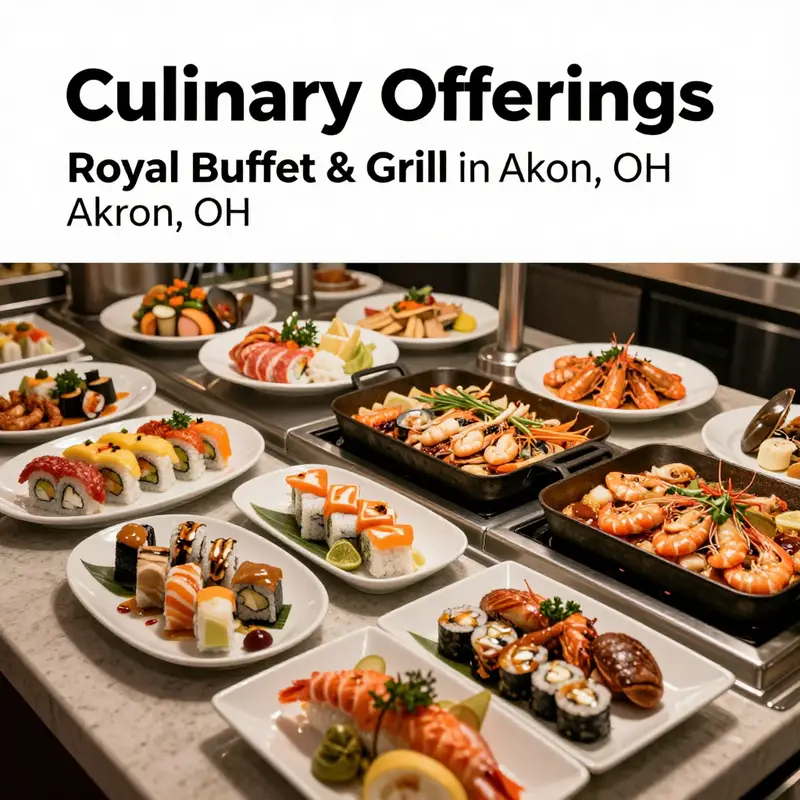
Tucked along Buchholzer Boulevard, the Akron location of Royal Buffet & Grill invites a steady stream of family gatherings, after-work dinners, and curious diners who want to sample a broad spectrum of Chinese and Japanese flavors in one sitting. The dining room feels designed for abundance rather than restraint, with a mosaic of steam tables, sushi stations, and hibachi grills that signal a generous, all-you-can-eat philosophy. The address at 1930 Buchholzer Blvd anchors a neighborhood scene where the clatter of chopsticks, the hiss of the hibachi, and the soft whirl of conveyor-style service blend into a familiar rhythm. As soon as guests step inside, the aroma of sesame, ginger, and soy pages across the senses, inviting a mindset of exploration rather than hesitation. The menu stands as a map of East Asian flavors presented in a way that makes it possible to circle back to favorite dishes without losing the sense of novelty that a vast buffet provides. In this space, guests aren’t choosing a single dish; they are choosing a retreat into a landscape of textures and temperatures, from the delicate tenderness of fresh sushi to the sizzle of grill-fired proteins that arrive at the table with a moment’s theater and a fanfare of steam.
The core appeal lies in the all-encompassing scope. Fresh sushi is a notable focal point, with rolls and nigiri that showcase a balance between precision and abundance. The roll lineup tends to emphasize contrasts—cool, clean fish against tangy garnishes, crisp vegetables against creamy sauces—and the sushi bar invites guests to gauge their appetite in real time. Adjacent to this, hibachi-style offerings provide an interactive dimension. A chef’s meticulous choreography—grill, flip, sear, and plate—transforms simple proteins and vegetables into a meal that feels both celebratory and comforting. The station becomes a stage where guests watch familiar techniques performed with practiced fluency, making the act of eating feel a little ceremonial, even as the price point remains approachable. Beyond the raw appeal of raw fish and the drama of the grill, the buffet presents a broad range of entrées that celebrate seafood, poultry, beef, and vegetarian choices in a steady parade of bowls, platters, and steaming trays.
Seafood, in particular, tends to anchor the experience. The freshest items—crisp-edged shrimp, tender fish, and a modest array of shellfish—combine with starches and seasonal vegetables to create balanced plates that carry a satisfying density. The hot entrees—braised, glazed, or pan-seared—offer comforting flavors that echo familiar takeout staples while benefiting from the buffet’s scale and freshness. Rice, noodles, and a spectrum of sauces—ginger, garlic, BBQ, and sweet-and-sour—act as flexible companions that let guests craft profiles that range from subtle to assertive. The dessert counter, often a bright counterpoint to the savory courses, becomes a gentle coda to the meal, featuring items that provide a sweet finish without overwhelming the palate.
Ambiance reinforces the sense of a shared dining event rather than a rushed meal. The space accommodates families, colleagues, and friends gathering for celebrations or a casual night out, with tables arranged to encourage conversation and the easy exchange of plates and recommendations. Service, attentive without being intrusive, helps sustain the rhythm of the buffet—glasses refilled, hot dishes refreshed, and plates cleared with a courtesy that signals both efficiency and hospitality. The result is a dining experience that rewards iteration. Even frequent visitors can discover new combinations—an unexpected pairing of soy-glazed beef with a bright cucumber salad, a spicy bite of tuna tucked into a bite-size roll, or a hibachi moment that introduces a dish the guest hadn’t noticed among the broader array.
To understand a buffet like this is to recognize how it functions as a cultural microcosm. It offers a panorama of flavors drawn from a shared culinary dialogue across Chinese and Japanese traditions. The best moments emerge when a diner allows the plate to guide the journey: a bite of crisp tempura, a chew of perfectly balanced sushi, a seared protein that carries a hint of caramelized crust. Each station acts as a station of discovery, inviting a traveler’s palate to compare textures and temperatures side by side. That sense of breadth is, in itself, a form of storytelling—one that narrates the restaurant’s philosophy of generosity and variety. Though the scene can sometimes feel busy, the core experience remains anchored in the pleasure of tasting a broad spectrum of dishes in a single, cohesive outing.
The Akron venue also sits within a broader tapestry of the brand’s footprint, a reminder that the culinary approach travels with a shared philosophy across locations. The experience here is not a caricature of a buffet but a carefully curated menu that emphasizes freshness and abundance. The menu has evolved with time, and guests are encouraged to verify the latest offerings through the official site, which provides snapshots of sushi selections, hibachi choices, and the hot-table lineup. This openness about what is currently on the menu helps guests plan their visit with a sense of anticipation, rather than surprise, and it reflects a broader trend toward transparency in dining experiences that aim to balance variety with reliability.
Beyond the surface of plates and presentation lies a more nuanced memory—the restaurant’s history and its complex place in the local narrative. In 2017, a federal case drew attention to the then-owners’ practices, a reminder that the life of a restaurant extends beyond meals and menus. The case highlighted issues around immigration and tax compliance involving two operators who had steered the business through years of operation. Such events shape public perception and contribute to a layered, sometimes controversial, backdrop to any long-running dining venue. Yet the physical space—the dining room’s glow, the clatter of utensils, the aroma of sesame—continues to host people seeking warmth, connection, and a destination for sharing meals. In the present moment, many guests arrive with memories of past visits and a sense of curiosity about how the restaurant has stewarded its offerings through time. The current dining experience, supported by a refreshed, clean environment and a menu that remains expansive, invites diners to judge the place by its present reality—one focused on flavor, hospitality, and value.
To those planning a visit, the question often reduces to what kind of feast they seek. For families and groups, the buffet’s breadth supports a democratic dining plan: everyone can sample a little of everything, from a delicate piece of sushi to a heaping ladle of noodles. For solo diners who want to explore, the arrangement provides a forgiving space where a person can sample, compare, and decide what deserves another round. And for those who regard food as a social ritual, the hibachi grill becomes a shared activity, a moment of performance that elevates ordinary dining into a small celebration. The Akron location’s current iteration, with its emphasis on variety, seafood highlights, and a lively sushi bar, reinforces the sense that a buffet can be more than a quick repast—it can be an edible itinerary through flavors that resonate across generations.
For readers who want a practical window into the Akron experience, a quick look at the Akron page offers a concise snapshot of how the menu and hours align with contemporary dining rhythms. royal-buffet-and-grill-akron serves as a helpful guide to the latest updates, helping travelers and locals plan a visit that fits their schedule and appetite. While the past casts a long shadow, the current dining room stands as a testament to the resilience and adaptability of a familiar neighborhood gathering place, offering a broad, forgiving space where flavors mingle, stories are shared, and plates accumulate with cheerful generosity.
External resource: https://www.royalbuffetandgrill.com
Final thoughts
Royal Buffet & Grill, despite its legal setbacks, remains a beloved destination for those seeking diverse culinary experiences in Akron. It’s crucial for business owners to understand the legal landscape in which they operate, as compliance can significantly impact their reputation and longevity. The restaurant’s rich offerings are a reminder of the importance of delivering quality service to customers, which can help rebuild trust and strengthen community ties following challenges. A restaurant’s story is not only told through its dishes but also through its ability to navigate the complexities of the modern business world.