
On high-dust job sites, most excavator hydraulic pump wear comes from fine particulate contamination. Particles under 10 microns pass through standard filters and abrade the tight clearances between pistons, bores, and valves, which makes filtration the main lever you have for slowing the damage and protecting pump service life.
Filter rating, media type, and service intervals all determine how much abrasive material reaches the pump. Small specification changes often produce outsized reliability gains, and a modest filtration upgrade can add hundreds of operating hours before a pump needs attention.
The sections below cover the root causes of pump degradation, how dust gets into a hydraulic system, the filter specifications that survive heavy dust, and the fluid monitoring and daily routines that catch wear before it becomes a failure. It is written for construction equipment operators, heavy machinery owners, and excavation firms working in abrasive, dust-heavy conditions.
The Mechanical Root Causes of Excavator Hydraulic Pump Wear
Hydraulic pumps wear out eventually, but they rarely fail by accident. Four mechanical mechanisms account for most excavator pump wear, and each attacks a different part of the pump at a different rate, with a different repair bill attached. Understanding them is the first step toward controlling them.
Abrasive Wear: Hard Particles Grinding Metal
Abrasive wear is the leading cause of premature pump failure, and it starts with grit. Silica dust, sand, and stray metal debris lodge in the clearances between the pistons, cylinder barrel, and valve plate – gaps measured in microns. Any particle larger than the oil film cuts metal as the parts slide past each other, cycle after cycle. Once contamination reaches the internals, the pump loses its internal seal; pressure and flow drop measurably, and a full rebuild or replacement follows long before the rated service life. A cheap filter turns into an expensive failure.
Erosive Wear: High-Velocity Fluid Cutting Surfaces
Erosive wear is quieter but relentless. Fluid speeding through internal passages or across a worn seal carries suspended particles that strike metal at high velocity and erode it away. Faster flow and sharper particles chip off more material with every impact. Because the damage happens inside the pump, the result is a slow, hard-to-diagnose efficiency loss that only becomes obvious once performance visibly sags.
Adhesive Wear: Metal Welding to Metal
Adhesive wear happens when two moving surfaces lose their oil film and touch. Friction micro-welds microscopic high spots together and then tears them apart, transferring metal and roughening the surface. Friction and heat escalate, accelerating every other wear mode and driving repair costs up quickly.
Cavitation: Fluid Starvation Tearing Metal
Cavitation comes from too little fluid, not too much dirt. When oil supply lags demand, pressure at the pump inlet drops below the oil’s vapor pressure and bubbles form; when they collapse against metal surfaces, the implosion energy pits and fatigues the metal like a tiny hammer. The outcome is severe internal erosion, overheating, and sudden catastrophic failure.
Three consequences show up across all four mechanisms:
- Shorter service life – wear compounds itself, so pumps fail years early.
- Rising repair costs – rebuilt components and downtime cost far more than filtration.
- Cascading damage – metal debris from one worn pump contaminates the entire circuit.
Control the four mechanisms and you control how long the whole machine lasts.
| Filter Type | Nominal Micron Rating | Beta Ratio Efficiency | Typical Contamination Target (ISO 4406 code) | Suitable Dust Load Level | Relative Service Interval |
|---|---|---|---|---|---|
| Standard return-line hydraulic filter | 10 – 25 micron | Beta 200 at 25 micron | 19/17/14 | Moderate dust load | Baseline (100%) |
| High-efficiency return hydraulic filter | 3 – 5 micron | Beta 200 at 5 micron | 17/15/12 | Moderate to high dust load | 25 – 40% shorter than baseline |
| Pressure-line hydraulic filter | 3 – 10 micron | Beta 200 at 10 micron | 18/16/13 | High dust load | 30 – 50% shorter than baseline |
| Suction strainer | 100 – 150 micron | Beta 200 at 100 micron | 21/19/16 | Extreme dust load (pre-filtration only) | Very long (rarely serviced) |
| Dual-stage filtration setup | 10 micron primary + 3 micron secondary | Beta 200 at 3 micron (final stage) | 16/14/11 | Extreme dust load | Longest element life but most service points |
A lower micron rating traps more pump-damaging particles, but tighter filtration also demands shorter service intervals to avoid bypass and element collapse.
How Dust Enters Your Excavator’s Hydraulic System
On a high-dust job site, the hydraulic system is under constant attack. Every retracting cylinder rod drags a film of grit past the wiper and rod seal. Every time the reservoir breathes as fluid levels rise and fall, unfiltered air carries fine silica in through the breather vent. During servicing, an open fill port, a loose quick-coupler cap, or a degraded hose jacket lets abrasive dust drop straight into the oil. Each of these is a small failure of contamination control, and they add up fast. Dust ingress rarely announces itself; it shows up later as rising oil temperature, sluggish response, and eventually a pump that howls under load.
Contamination comes from two streams. Airborne ingress is outside material pulled in through breather vents, cylinder rod seals, reservoir openings during servicing, quick couplers, and cracked or worn hoses that no longer seal. Generated particles are metal shavings, seal fragments, and varnish flakes produced by wear and heat cycles inside the machine. The two feed each other: ingressed grit scratches surfaces, the scratches shed new metal, and that metal circulates again. Particles in the 4 to 14 micron range do the most damage, because they are small enough to pass through many standard filter media and still large enough to bridge the tight clearances in a pump. A quality hydraulic filter rated for that range cuts the wear that quietly drains your machine.
The most common contamination pathways on dusty sites include:
- Breather vents – where the reservoir breathes, drawing unfiltered air in with every fluid-level change.
- Cylinder rod seals and wipers – the sliding interface that drags grit past the seal and into the oil on every cycle.
- Reservoir openings, quick couplers, and degraded hoses – service-time exposure points and cracked jackets that bypass proper filtration entirely.
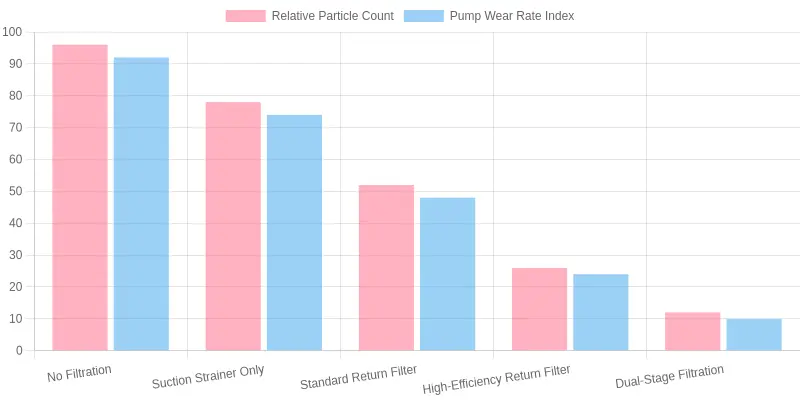
As filtration grows finer, relative particle count and the pump wear rate index fall together, confirming that finer filtration reduces the particle count that drives excavator hydraulic pump wear.
Filtration Choices That Match Dust-Heavy Conditions
Dust-heavy job sites turn hydraulic fluid into a slow-moving grinding compound. Every abrasive particle that slips past a filter accelerates excavator hydraulic pump wear, so the question is not whether you filter but whether your filtration matches the severity of the environment.
Micron Rating Selection
A micron rating is a moving target, not a fixed number that means “clean”; the dirtier the site, the tighter it should get. Most excavator pumps on high-dust sites call for filtration in the 3 to 10 micron range, because particles in the 4 to 14 micron band are small enough to slip between moving surfaces and hard enough to gouge them. On a demolition or quarry site, spec a 3 to 5 micron absolute rating for the return or offline loop instead of relying on a standard 10 micron nominal element.
Reading Beta Ratios Correctly
The beta ratio tells you how efficiently a filter captures particles at a stated size, and it matters more than the micron number alone. A beta 200 rating at 5 microns (written B5 = 200) means 200 particles of that size enter for every one that passes – about 99.5 percent capture efficiency. If contamination control matters, ask for absolute-rated elements with a documented beta value, and treat vague “high efficiency” marketing claims as a warning sign.
Filter Media Types
Cellulose, synthetic, and wire mesh behave differently under abrasive loads. Cellulose (paper) media is cheap but sheds fibers and collapses under high differential pressure. Synthetic glass-fiber blends hold more dirt and keep their efficiency longer. Wire mesh is cleanable and nearly indestructible, but it only stops relatively large particles. In dusty conditions, run synthetic media in the main pressure and return filters and reserve wire mesh for suction strainers and coarse pre-filters.
Bypass Valve Settings
A bypass valve that opens too early dumps unfiltered oil back into the system. As a filter loads with dust, differential pressure rises; if the crack pressure is set too low or the spring is fatigued, oil routes around the saturated element and carries contaminants straight to the pump. Check the bypass crack pressure against the filter manufacturer’s specification, and do not upsize an element just to cut down on nuisance bypass events.
Reservoir Breather Filtration
The breather is the most overlooked entry point for dust. Every time the fluid level drops, the reservoir draws in outside air, and an unprotected breather pulls airborne grit straight into the tank. Fit a spin-on or desiccant breather rated at 3 microns or finer, and replace it on the same schedule as your main filters.
Matching Specs to Dust Exposure
The right specification depends on how much dust the machine actually breathes. Concrete crushing, demolition, and dry-soil trenching generate far more airborne particulate than wet or paved sites, so two identical excavators often need different elements. Grade each machine as low, moderate, or severe exposure, then step up micron rating, media type, and breather quality to match – and shorten service intervals as severity rises.
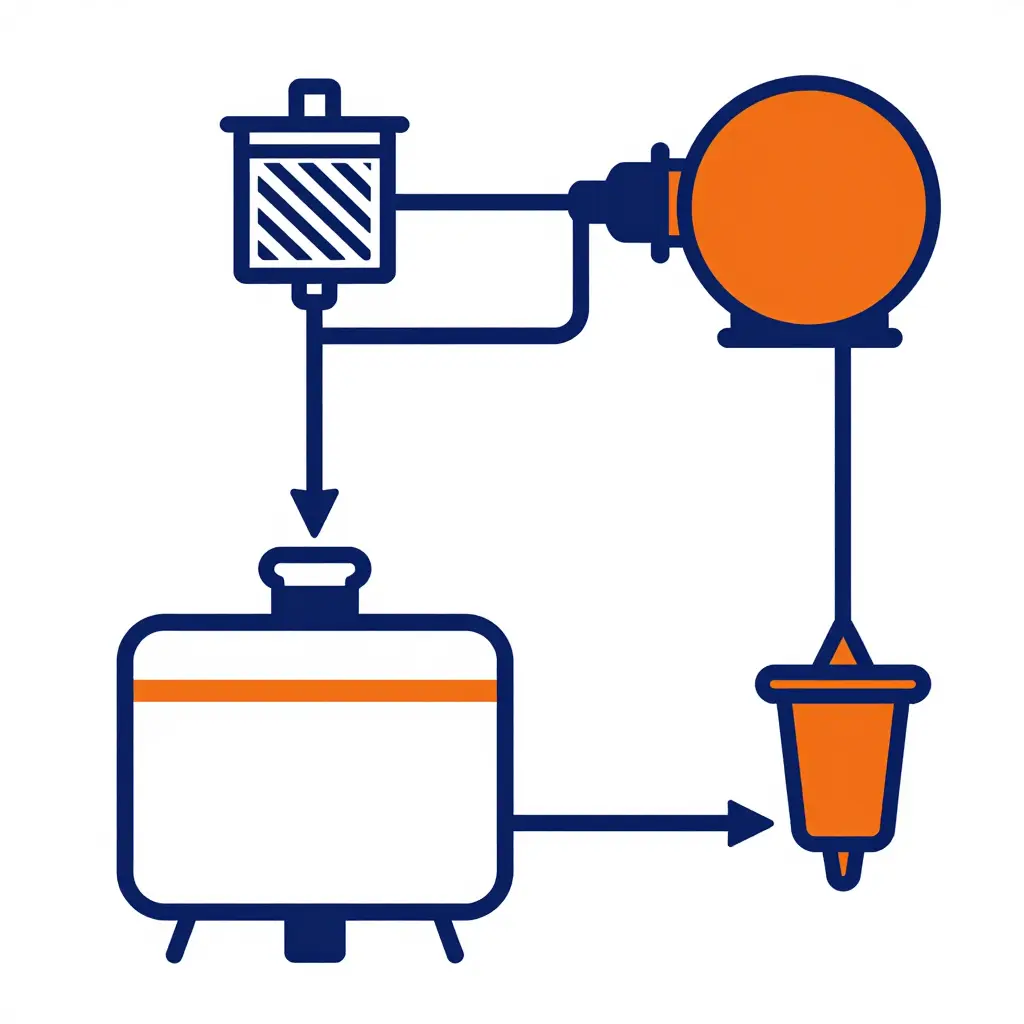
The schematic traces how contaminated fluid moves through a hydraulic circuit before reaching the pump.
Filtration Best Practices for High-Dust Job Sites
-
Select the correct micron rating. Match the filter’s micron rating to the pump manufacturer’s cleanliness tolerance rather than guessing; particles in the 4 to 14 micron range drive most excavator hydraulic pump wear. Too coarse a filter lets abrasive silt circulate, while too fine a one can choke flow and spike oil temperatures. The goal is a filter that removes damaging debris without starving the system.
-
Upgrade to high-capacity breather filters. Replace standard breather caps with spin-on or desiccant units that trap dust before it enters the reservoir. On high-dust sites, fluid levels rise and fall constantly, pulling airborne grit into the tank; a proper breather adds a barrier ordinary caps cannot provide. The payoff is cleaner fluid and slower contaminant buildup between service intervals.
-
Seal every reservoir opening. Inspect and reseal filler caps, dipstick ports, inspection covers, and unused ports with fresh gaskets. A single loose cover can admit more dust than the main element captures, and leaks around these openings are easy to overlook. Sealing them keeps the reservoir atmosphere closed and extends hydraulic filter life.
-
Pre-filter fluid before top-off. Run replacement oil through a dedicated transfer filter or fine-mesh strainer before it reaches the reservoir; new fluid is rarely as clean as operators assume. Pouring it in unfiltered adds a fresh dose of particles with every top-off. Pre-filtering keeps incoming fluid within target cleanliness and keeps you from adding contamination yourself.
-
Shorten filter change intervals. On high-dust sites, cut the service schedule to as little as half the standard interval; elements load with debris far faster when the air is thick with grit, and hour-based intervals do not account for it. Shorter intervals keep the bypass valve from opening and releasing a sudden surge of trapped particles.
-
Adopt ISO 4406 cleanliness targets. Set a measurable ISO 4406 target – 18/16/13 for the system, for example – and verify it with routine oil sampling instead of visual inspection. A numeric target turns contamination control into a trackable metric, and hitting it directly reduces excavator hydraulic pump wear and the repair bills that follow.
-
Inspect rod seals and wipers regularly. Look for cuts, hardening, or gaps in cylinder rod seals and wiper rings. A failed wiper lets dust ride into the hydraulic system on every stroke, and these parts are the front line on dirty sites. Replacing them early stops contamination at the source and keeps the filter from being overwhelmed.
-
Train operators on contamination control. Coach operators on clean fill practices, correct filter handling, and keeping caps and tools clean. Habits decide whether filtration works: a short training session prevents the sloppy top-offs and open reservoirs that defeat good hardware, and a crew that treats cleanliness as part of the job gets longer runs between failures.
Filter Maintenance and Contamination Monitoring on High-Dust Job Sites
On a dusty site, fluid sampling is the cheapest insurance against excavator hydraulic pump wear. Oil that looks clean can still carry abrasive silt fine enough to wipe out precision tolerances, so visual checks tell you almost nothing. Instead of following a relaxed factory calendar, treat contamination control as a measured discipline: pull a sample every 250 hours (or monthly during peak demolition and trenching work), and sample from a live, warm circuit rather than a drain plug.
Two measurements tell the story. ISO 4406 particle counts show what is really circulating: a code such as 18/16/13 encodes the particle count per milliliter above 4, 6, and 14 microns, and a rising first number means the hydraulic filter is no longer keeping up. Differential pressure across each filter is the other signal; as the element loads, ΔP climbs, and at the peak a bypass indicator pops and routes unfiltered oil straight to the pump. If that bypass trips even once, wear begins.
Several conditions justify shortening change intervals toward or beyond the OEM recommendation: sustained ISO codes above your target, steadily increasing differential pressure, a tripped bypass indicator, visible dust ingress at breathers or seals, or repeated high-hour shifts in rock and concrete debris. When any of those appear, move from fixed intervals to condition-based changes. A hydraulic filter is only as good as the schedule behind it.
If the bypass trips more than once in a service cycle, do not wait for the next sample. Inspect the breather, reseal the reservoir, and verify the return filter is correctly sized for your flow. Those corrections cost little and keep abrasives out of the pump.
Frequently Asked Questions
What micron rating do I need for a high-dust job site?
Most excavator hydraulic systems on high-dust sites run best with a hydraulic filter rated 3 to 10 microns nominal and an ISO 4406 target around 16/14/11. Particles in the 4 to 14 micron range cause most sliding wear inside pumps, so catching them matters far more than trapping large debris. Look for Beta-rated media – Beta 200 at 6 microns is a measurable, defensible rating rather than a vague label. Start with the pump manufacturer’s recommendation and tighten it only when oil analysis shows wear metals climbing.
Will a finer filter starve my hydraulic fluid?
Not if the filter is sized correctly and bypass settings are right. Fluid starvation usually traces back to a clogged element, cold oil, or an undersized housing, not to pore size itself. Modern synthetic media flow well enough to pass full pump output while still capturing fine particles. If you notice cavitation or rising temperatures, inspect element loading and cold-start viscosity before blaming the micron rating.
How often should I change hydraulic filters in dusty conditions?
On high-dust job sites, plan on changing the hydraulic filter every 250 to 500 hours, or sooner when the restriction indicator enters the caution zone. Dust loads an element two to three times faster than clean indoor operations do. Go by differential pressure gauges instead of a fixed calendar so you replace filters according to real loading, and cut open a used element now and then to confirm it is actually catching the debris you expect.
Is a suction strainer enough to protect my pump?
No. A suction strainer is a coarse last line of defense, not a replacement for full-pressure filtration. Strainers catch only large debris and let the fine wear particles that damage pumps pass straight through. They protect against catastrophic intake blockage, not abrasive wear. Keep the strainer clean and pair it with proper return and pressure filtration.
How do ISO 4406 codes relate to excavator hydraulic pump wear?
ISO 4406 codes report particle counts per milliliter above 4, 6, and 14 microns, and higher numbers mean dirtier oil. Most excavator pumps last longest when oil stays at or below roughly 16/14/11. Each step the code climbs raises the concentration of wear-causing particles and shortens pump life, so tracking the trend tells you whether your filtration choices are genuinely working.
Is synthetic filter media worth the higher cost?
Usually, yes. Synthetic media hold more contaminant and keep their efficiency longer than cellulose, and they resist collapse under high differential pressure – which matters in dusty, high-vibration excavator service. Longer service intervals also cut labor and downtime. Once you factor in extended pump life, the upfront price difference becomes small.
Conclusion: Smarter Filtration Choices Extend Pump Life
Filtration is the most cost-effective defense against excavator hydraulic pump wear on high-dust job sites. Matching filters to the contamination around your machine stops abrasive particles before they reach critical pump components, and every hour a filter runs overdue is an hour abrasive dust spends grinding pump surfaces.
The chain is direct: tighter micron ratings capture more damaging particles, better contamination control keeps fluid cleaner, and cleaner fluid delivers longer, more predictable pump service life.
Three groups have a role:
- Construction equipment operators – check and replace elements on schedule, monitor pressure differentials, and never run with a bypassed filter.
- Heavy machinery owners – specify filters rated for high-dust job sites and stock spare elements before the busy season.
- Excavation firms – standardize filtration across the fleet and track pump hours against filter change intervals.
Cleaner hydraulic fluid means fewer breakdowns, lower repair bills, and more billable machine hours. Treat filtration as planned protection rather than a reactive expense.