
Royal Buffet Berlin NJ Dinner Rush: Why the Crab Leg Station Sets the Queue
The crab leg station is the main reason a line forms during the dinner rush at Royal Buffet Berlin NJ. Watch the room for ten minutes on a Friday or Saturday night and the pattern is hard to miss: the whole crowd rearranges itself around one tray.
Walk in around 6 p.m. and you’ll see it. A slow, patient snake of diners hugs the hot bars, plates balanced, eyes on a single tray. Steamed snow crab clusters come out in batches, the tray empties in seconds, and the line resets. The wait isn’t a flaw in the layout. It’s what happens when everyone wants the same thing at the same time.
What follows covers when the crab station peaks and when it slows, how the legs are served and replenished, what to grab while you wait, and which backup dishes are worth the plate space. There are notes on seating and timing too, plus a few habits that make a visit easier.
The crab legs get the attention, but they aren’t the only reason people drive across Camden County for this place. The other stations move fast, the two systems feed each other, and knowing how they work together is what keeps a dinner rush from turning into a scramble.
What the Dinner Rush Looks Like
A packed all-you-can-eat seafood buffet at 6 p.m. on a Friday is a lot to take in. Here’s how it actually moves at Royal Buffet Berlin NJ.
Peak arrivals land between 5:30 and 7:30 p.m., with Friday and Saturday nights and holiday weekends drawing the biggest crowds. Sunday after church brings an earlier, family-heavy surge. Come before 5 p.m. or after 8 p.m. and you’ll usually walk straight to a table.
The dining floor is built for flow. Tables ring the perimeter and the buffet islands sit in the center, so guests move in loose loops instead of one jammed line. Cold stations, hot entrée lines, a carving area, a hibachi-style grill, and a dessert island each hold their own zone.
Queues form at only a few spots because foot traffic concentrates wherever the perceived value is highest. At a seafood buffet, that means crab legs, shrimp, and oysters. Guests load up on the premium items first, linger while they pick through them, and create a bottleneck. The fried and grilled stations sit close behind.
That pattern is easy to work with once you know it. Whether you live nearby or are just passing through, a South Jersey buffet like this one rewards a little timing strategy. Learn more about the Royal Buffet Berlin NJ experience and plan around the rush instead of into the middle of it.
Why the Crab Leg Station Sets the Longest Buffet Queue
The crab leg station usually draws the longest line, and hunger alone doesn’t explain it. Crab legs look like the most expensive item on the line, so they anchor how diners judge the value of an all-you-can-eat meal.
Supply drives the rest. Crab legs arrive frozen, and the kitchen boils, chills, and refills them in batches. When a fresh tray lands, a crowd appears within seconds. When it empties, often in under two minutes, everyone waits for the next one. That stop-start rhythm builds a queue even when the rest of the buffet is wide open.
Portions compound it. Most guests treat crab legs as the payoff and stack a tall pile on the first trip, and many buffets keep diners to a few clusters per visit, which sends them back to the line sooner. Rice, noodles, and the carving station refill continuously and rarely inspire a stampede. Diners rank crab legs above nearly every other item, so they’re willing to wait.
Scarcity does the rest. All-you-can-eat doesn’t mean all-is-available, and an emptying tray triggers a mild grab-it-now reflex. Crab legs aren’t slow to cook. Demand simply spikes whenever supply resets, and that keeps the line dense and slow.
The practical point: at Royal Buffet Berlin NJ, watch the refill rhythm, not the clock. Step in right after a fresh tray drops, or wait until the first wave clears.
Every station at Royal Buffet Berlin NJ runs on its own clock and draws a different crowd, and reading those paces is the fastest way to skip the longest wait. Explore the full Royal Buffet Berlin NJ buffet lineup before you go.
| Station | Typical Popularity | Refill Frequency | Tendency to Form a Queue |
|---|---|---|---|
| Crab Legs | Highest – the undrawn dinner-rush headliner | Roughly every 10-15 minutes; trays vanish fast | Very high – a proper line forms the moment a fresh batch lands |
| Sushi | Steady staple among regulars | Continuous, in small rolling batches | Low – most guests grab a roll or two and move on |
| Hibachi Grill | High with families and bigger groups | Made to order, so it never truly refills | Medium – wait time depends on how many orders are stacked up |
| Hot Chinese Entrees | Broad, comfort-food appeal | Frequent, often every 5-10 minutes | Low – spread across several serving spots |
| Dessert | Popular in the final act of the meal | Periodic, refreshed between rushes | Low – only short bursts right after main courses wind down |
Plan your first plate around the crab legs, then let the faster stations fill in the rest of your meal.
The traffic pattern works like water through a funnel. A wide, easygoing stream of diners wanders the floor, narrows to a single-file squeeze at the crab leg station, then fans back out once plates are loaded. That narrow middle is the bottleneck, and it sets the tempo for the whole room.
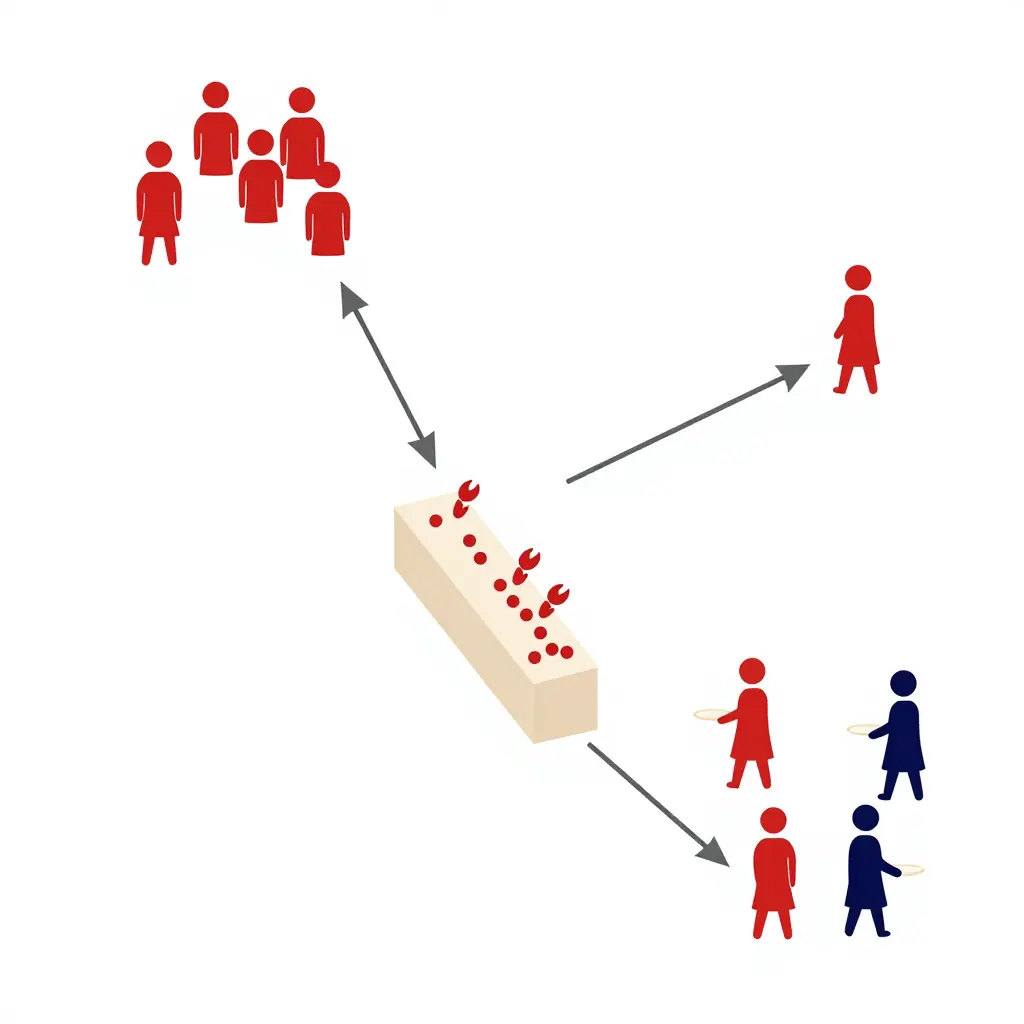
The diagram reads left to right:
- The approach (left): diners arrive in a loose, scattered pattern, no real order yet.
- The convergence (center-left): the crowd funnels into one lane because the prize sits in a single spot.
- The bottleneck (center): the buffet counter itself, where tongs, crab legs and one pair of hands set the pace.
- The divergence (right): once the grab is made, diners peel off in every direction and the pressure releases.
If you want to see this flow in person, swing by on a weeknight, when the stream moves a lot more smoothly than on a packed Friday. You can check current hours and directions for Royal Buffet in Berlin, NJ before you head over.
Insider Tips to Beat the Crab Leg Queue
The crab leg line at Royal Buffet Berlin NJ is longest between 6:00 and 7:30 p.m., the heart of the dinner rush. To beat it, arrive early: 4:45 to 5:15 p.m. on weekdays, and no later than 4:30 p.m. on Fridays and Saturdays. The trays are still full at that hour, and you can walk straight up.
Watch the refill cycle. Crews restock the station roughly every 12 to 15 minutes once the crowd thickens. If a tray looks picked over, don’t join the back of the line. Linger nearby and slip in as the fresh batch hits the steam table. Warm legs taste better than lukewarm ones.
Sequence your stops. Don’t sprint to the crab legs first. Grab a small plate of sides, eat quickly, then loop back once the first wave has thinned. A second crab leg run just before dessert usually meets the shortest line, and a quick round-trip to your table keeps you moving while everyone else stands still.
One scouting lap before you commit shows you where the crab leg station sits relative to sushi and hibachi. Curious about the full layout? See what else is waiting on the Royal Buffet Berlin NJ menu before you go.
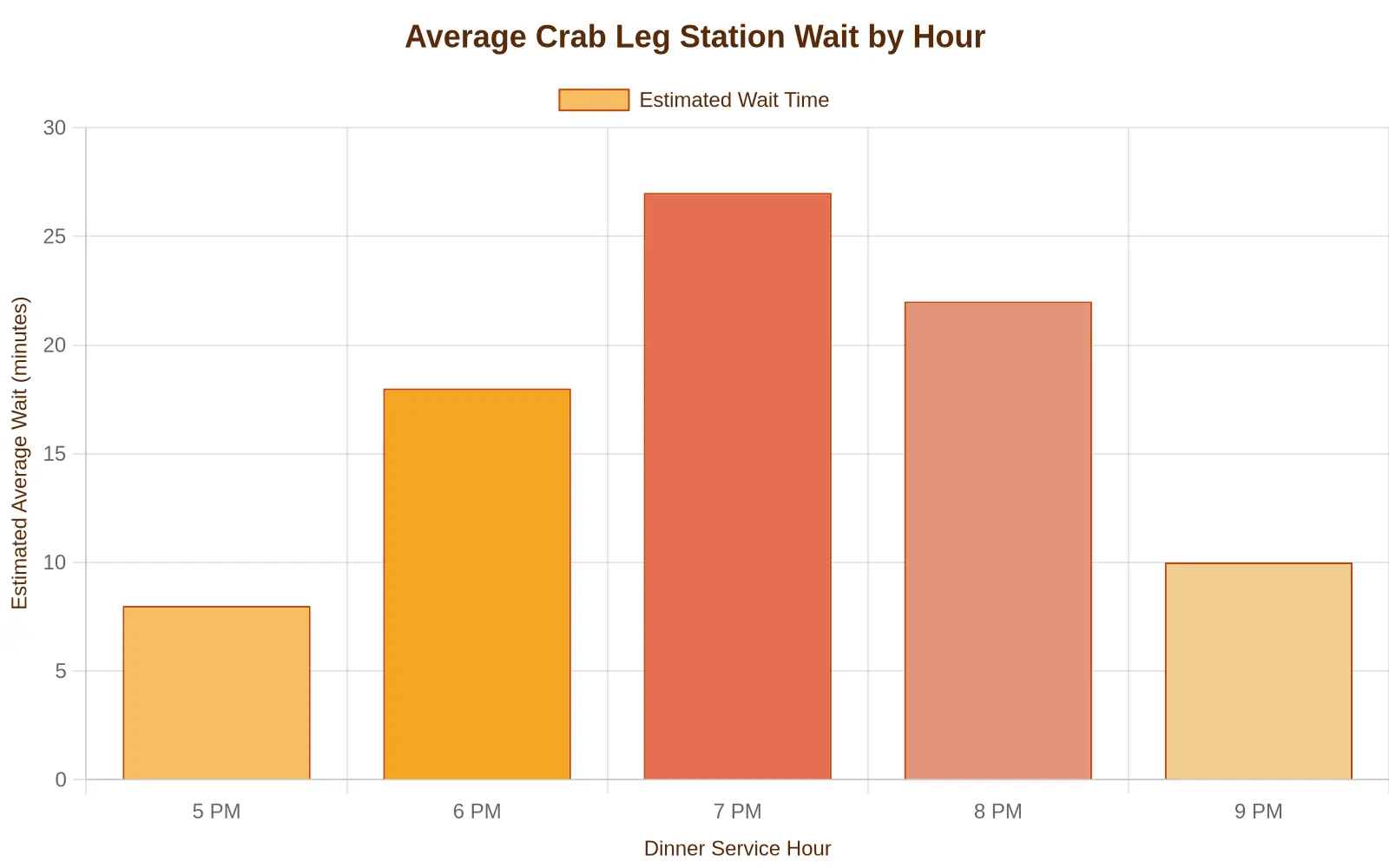
Average Crab Leg Station Wait by Hour
| Dinner Service Hour | Estimated Average Wait |
|---|---|
| 5 PM | 8 minutes |
| 6 PM | 18 minutes |
| 7 PM | 27 minutes |
| 8 PM | 22 minutes |
| 9 PM | 10 minutes |
The wait climbs through the evening, peaks near 27 minutes around 7 PM, then falls back toward 10 minutes after 8 PM as the room clears. Treat these as ballpark estimates rather than a fixed schedule.
Figure 1: The crab leg station queue peaks during the 7 PM dinner rush, so arriving early (before 6 PM) or later (after 8 PM) is your best bet for a shorter wait.
For hours, directions, and daily specials, check the Royal Buffet Berlin NJ location page.
Families and Groups: Timing the Crab Leg Station Together
A big group changes the math at the crab leg station. The more people at an all-you-can-eat buffet, the more hands reach for the legs at once, and the faster the tray empties. At a busy seafood buffet like Royal Buffet Berlin NJ, a table of eight can create its own mini rush.
The fix is to split up. Send one or two people to scout the line while everyone else collects sides, sushi, and drinks first. Nobody stands around hungry while the crab legs get restocked.
A few moves keep the whole group happy:
- Stagger your turns. Two or three at a time, not the whole table.
- Watch the refill rhythm. Fresh trays land in waves, so time your walk right after one.
- Grab plates, not piles. Take what you’ll eat now and circle back for more later.
Young kids and grandparents tend to prefer the calmer stations, so let them settle in while the crab lovers take the first shift. Everyone eats, and the wait feels shorter.
Reading the Floor Before You Dive In
Picture the dining room at our Berlin, NJ location from above. The crab leg station sits center-front, closest to the main walkway, which is exactly why it becomes a bottleneck: everyone crosses it and everyone stops. The schematic below shows how it relates to the sushi, hibachi, and dessert stations, plus the one-way traffic loop that keeps a group moving instead of crashing into each other.
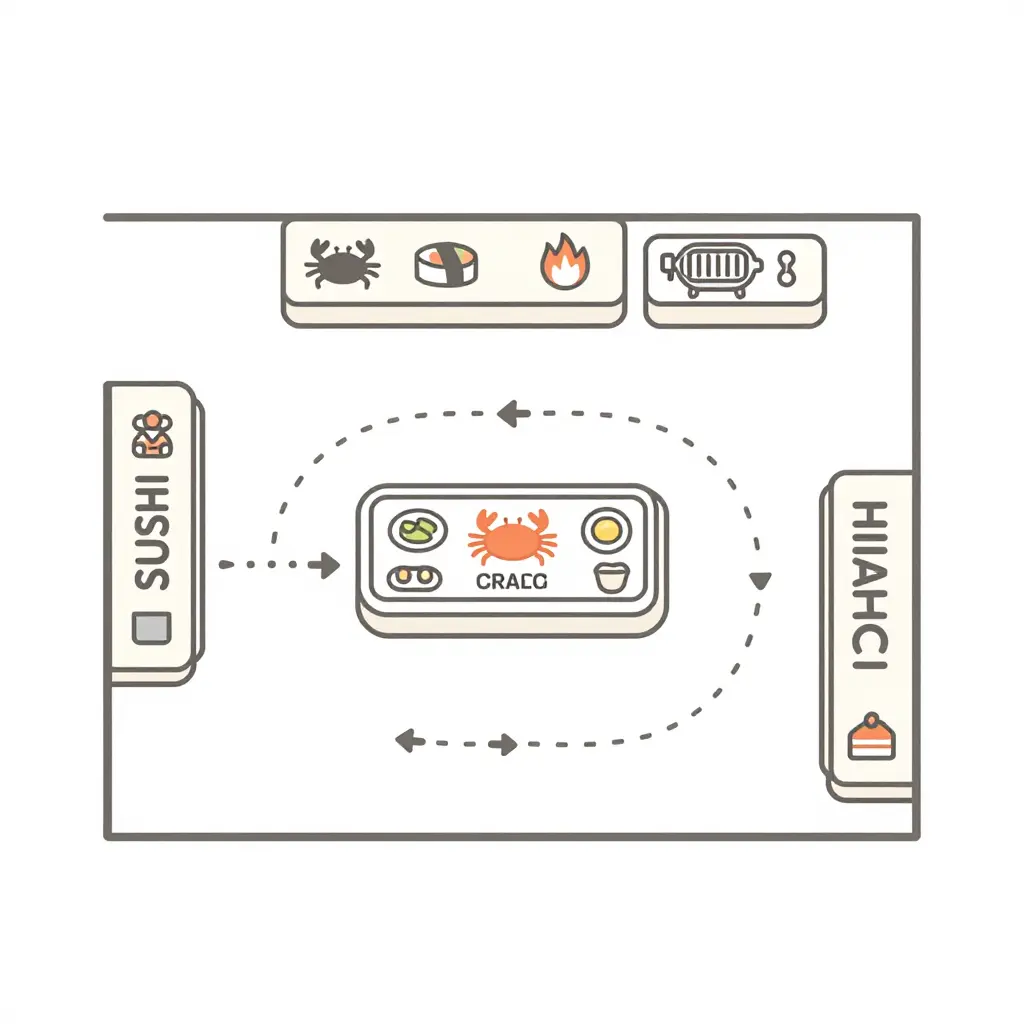
How to Split and Conquer as a Group
Treat the floor like a relay race, not a stampede. Read the schematic and assign roles:
| Station | Your Move | Why It Works |
|---|---|---|
| Crab legs (center-front) | Send one or two people to hold the prime queue spot | This is the longest line – get a body in it early |
| Sushi (left) | One diner grabs a shared platter on the way in | Quick to load, no waiting once the tray is full |
| Hibachi (right) | Time your arrival between cook batches | Fresh off the grill tastes best, and no idle standing |
| Dessert (back) | Save it for the last loop | Never queue for it during the rush peak |
A Simple Flow That Actually Works
- Start on the left – hit sushi first while it’s quiet and pile a plate for the table.
- Move center-front next – join the crab leg line right after, before it doubles in length.
- Swing right to hibachi – by now your crab legs are in hand and you can catch a fresh grill batch.
- Loop to the back for dessert last – the dessert station almost never bottlenecks, so it’s a calm finish.
One Pro Tip for Big Tables
Send one person counter-clockwise and another clockwise around the room. They’ll meet back at the table twice as fast, and nobody spends the whole dinner waiting behind someone else’s empty plate.
Keep the schematic in mind, or screenshot it, and the dinner rush stops feeling like a scramble.
The Value Beyond the Crab Legs
The crab leg line gets the attention, but it’s only part of the meal. Those snow crab clusters are the headliner; the rest of the buffet is why people come back.
A good seafood buffet isn’t built on a single dish. It’s built on choice, and this one has plenty. Beyond the crab there’s peel-and-eat shrimp, crispy fried fish, mussels, and fresh sushi rolls. Then the classics: sizzling hibachi, saucy General Tso’s chicken, slow-cooked ribs, plus spring rolls, dumplings, and stir-fried noodles for anyone skipping seafood.
It’s all-you-can-eat, so you don’t have to choose just one. Go back for thirds. Build the surf-and-turf plate you came for.
Want to see the lineup before you head over? Take a look at the full Royal Buffet menu and plan your attack.
The crab leg queue can stretch, but that wait is part of the evening: a few minutes to build an appetite, talk with your table, and plot the first move. By the time you sit down, the wait is forgotten.
Share of Diner Plates by Station During Dinner Rush
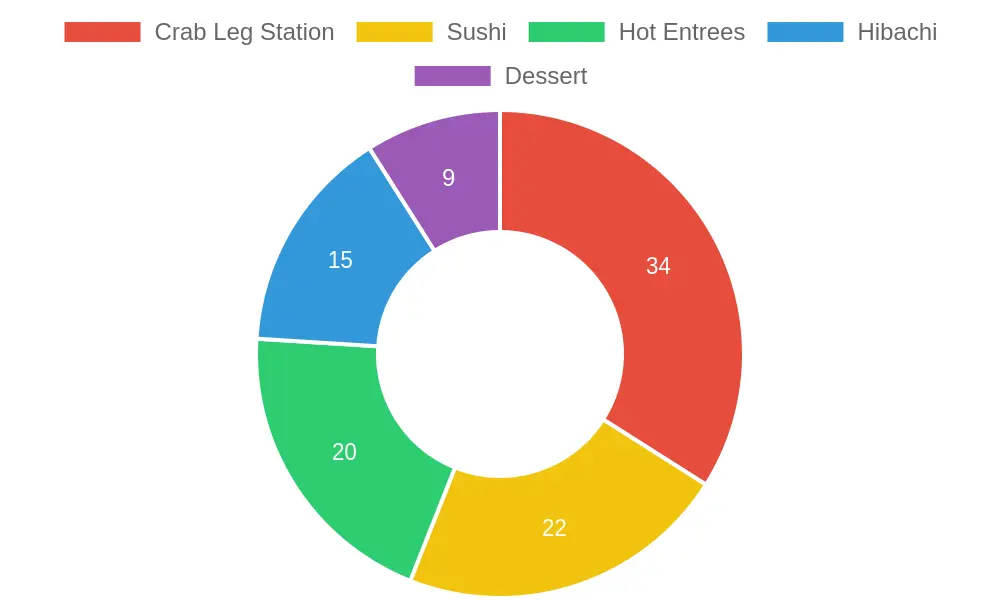
During the dinner rush, the crab leg station draws the largest share of diner plates at roughly 34%, far outpacing sushi, hibachi, hot entrees, and dessert.
The crab leg station doesn’t just draw the longest line; it takes the biggest share of the plate at the busiest hour. To see how the rest of the lineup compares on your next visit, explore the full Royal Buffet Berlin NJ buffet layout.
About a third of everything leaving the buffet at peak service comes from one station, which is why the queue forms there first. Sushi and hot entrees split the middle of the pack, hibachi holds its own on made-to-order appeal, and dessert closes the ring.
| Station | Share of Plates |
|---|---|
| Crab Leg Station | 34% |
| Sushi | 22% |
| Hot Entrees | 20% |
| Hibachi | 15% |
| Dessert | 9% |
If crab legs are the goal, timing matters more than anything else. Hit the station early, or slip in after the first wave clears.
The Bottom Line: One Line, One Reason
The crab leg station is why the Royal Buffet Berlin NJ dinner rush funnels into a single queue. It’s supply and demand, and regulars know where the value sits. That one line shapes the whole evening, from when you arrive to how you build your plate.
Come early, before 5 PM, or ride in after the first wave. Scout the layout before you grab a plate. Hit the crab legs first, and watch refill timing for the freshest haul. Bring an appetite, pace yourself, and let the buffet handle the rest. Come see the crab leg station in action during a dinner rush yourself.